Showing posts with label Manufacturer. Show all posts

Thursday, 22 September 2022

Instances When Permanent Mould Casting Is Preferred

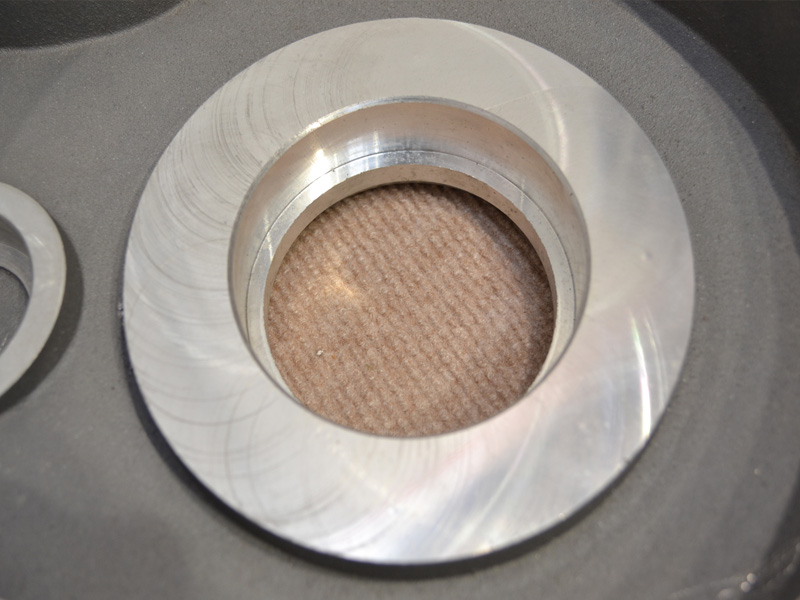
Sand casting and permanent mold casting are two different but related procedures that are each ideally suited to particular situations and requirements. Permanent mold casting is the practice of using the same mold again, as opposed to breaking it off after each use as is the case with sand casting. The term permanent refers to the mold's continuous usage, even if the mold is not genuinely permanent—as with any process and tooling, it will deteriorate with time and ultimately need to be refurbished or replaced. The permanent mold casting aluminum process's fundamentals are broadly identical to those of other casting processes: A mold cavity is filled with molten raw material, which is then allowed to cool before being removed.


Using a single reusable mold, permanent mold casting produces a huge number of castings. Simply pouring molten metal into a mold, where it cools and hardens, is the casting process. The casting is then taken out of the mold, which is then opened and utilized again. The mold is constructed from a high-temperature metallic substance that can survive repeated heating and cooling associated with large-scale production, such as cast iron or hot work die steel.


Permanent mold casting: when is it used?

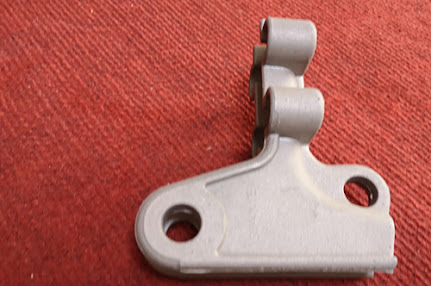
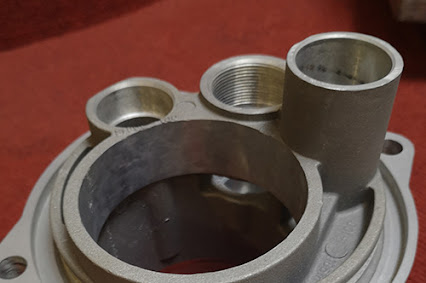
The method is typically used for items that need to be stronger and more durable. permanent mold aluminum casting is frequently used for the following purposes:

  • Components for HVAC and ventilation, such as fan blades and blowers
  • a valve body
  • a pump's parts
  • Castings for inserts
  • electronic enclosures
  • casts for brakes
  • Manifolds


Permanent mold casting Benefits

The following benefits of permanent mold casting might make your selection between it and sand casting a little bit simpler:


Strengthening: The porosity of a sand mold contributes to the end part's lower strength. Permanent molds made of iron or steel never show this type of problem.


Smooth finish: Permanent mold casting by permanent mold casting aluminum manufacturer have a smoother surface as compared to the sand-casting technique. Both casting techniques may be made smoother by adding additional steps, including polishing.


Dimensional accuracy: Permanent molds may create items with more exact tolerances than sand.

Get to Know About the Permanent Mold Process

Permanent molds for permanent mold casting are made in two pieces, which are then split apart when the material has cooled. Continue reading for a more thorough explanation of the procedure as well as some modifications to the standard, gravity-based feeding procedure:


Mold development: A pattern, which is a single piece in the form to be cast and is normally made by machining, will be used to construct a permanent mold. Iron or steel are the most used materials for permanent molds.

Mold preheating: Before the procedure begins, the mold will be heated to ensure that the molten material may flow easily through it without cooling or solidifying too quickly. Preheating has the advantage of reducing some of the thermal shocks that molten material normally produces. A cold mold would respond to the significant temperature difference in the raw material much more brutally.

Choice of core location: To create component characteristics like cavities and undercuts, cores can be inserted into a permanent mold during permanent mold casting China.

The raw material is liquefied and then poured into the mold cavity using one or more sprues in this phase, such as aluminum. While gravity alone can complete this phase, alternative techniques including low-pressure casting and vacuum casting are also an option.

Cooling: For complete solidification, a minimum cooling time is needed, depending on the size and shape of each item. The following and last phase take place when the cooling period has passed.

Removal of the component from the mold: As previously noted, permanent molds for the Permanent 

Mold casting processes are made in two parts, which are separated when the item is fully hardened and ready to be removed. To keep the piece from adhering to the mold, the inside surfaces of the cavity are occasionally coated with a substance. The mold may also have ejector pins. Any extra material, such as a flash or material from runners, will be cut after ejection. Parts will then be transported from this point via procedures including heat treating, aging, and other essential finishing needs.

Wednesday, 17 August 2022

Get an In-depth Knowledge about the Gravity Die Casting

Cast iron, steel, and heat-resistant iron alloys are the most often used materials for die-making in Gravity Die Casting. Other materials, such as aluminum, copper, or graphite, may also be utilized to create the dies for some particular uses. A metal die may create castings that are cleanly cast, with smooth surfaces, and with extremely high dimensional precision.


Very little to no final machining or other finishing is necessary for these castings. The number of castings that metal die can make throughout its service life can vary, and this relies on a variety of variables, including the casting material, the die material's resistance to thermal metal shock, and the temperature at which it is poured, and the casting technique used.


Gravity Die Casting


The pattern from which the die is formed must be designed with a lot of different considerations in mind. For instance, risers and the pouring-gate system must be taken into account so that the molten metal may be quenched by the mold walls more quickly than with sand casting. To allow air from the heated metal to escape from the die's interior, the die must also be equipped with channels at the joints and air vent holes.


Additionally, the die must be made so that it won't impede the shrinkage that takes place while the metal cools. Designing the cores that make up the casting might be challenging because of shrinkage. The cores are often comprised of steel or specific alloys, however, they can sometimes occasionally be composed of compressible sand or shells. Gravity Die Casting China is much preferred.


Gravity Die Casting


The molten metal can be poured in at the top of basic castings. It should be made to enable a fast, turbulent flow of molten metal into all areas of the die.


When producing heavy castings, slowly moving or tilting the die during the Gravity Die Casting Process helps minimize turbulence and make the metal flow more smoothly. Vacuum application may be used to aid die filling for castings with odd shapes. Slush casting is a method for creating hollow or decorative castings in which the molten metal is poured into the die and the excess liquid is thrown out after a solid shell of suitable thickness has formed.


Follow us on Facebook

Monday, 16 May 2022

Complete Overview of Gravity Die Casting

In manufacturing casting parts from non-ferrous materials such as aluminum or low-temperature alloys, there is the use of gravity die casting. For a wide range of industrial applications specifically in the defense, medical and energy sectors this process is used to create intricately shaped components.

In the process of gravity die casting there are four major steps involved. First of all, before being clamped together the two halves of the die are heated and sprayed with a coating.

The lubrication helps to prevent premature solidification and it even helps in the removal of the casting.

gravity die casting

Into the cavity of the die, the molten metal is then poured. The metal solidifies at a rapid rate before it gets cooled. Finally, the cast parts are removed and the die is opened.

Over other equivalent manufacturing processes, there are several key benefits. These include:

  • high production rates - in one day many hundreds of castings can be produced
  • excellent dimensional accuracy – It provides durability and dimensional stability
  • versatility
  • Higher tensile strength and improved mechanical properties – It shows high strength and mechanical properties as compared to sand casting.
  • multiple finishes - smooth or textured surfaces can be produced and there is a need for only minimal finishing

Gravity Die Casting China is even referred to as a permanent mold casting, typically uses alloys of non-ferrous materials such as aluminum, copper, magnesium, and zinc. As implied by the name, to fill the mold with molten metal gravity die casting relies solely on the forces of gravity. There is variation when compared to other casting processes which use an applied force or pressure.

Gravity Die Casting

Gravity die casting process

At the start of the Gravity Die Casting process, the die is heated and sprayed with a refractory coating. This coating helps in controlling the temperature and assists in the removal of the casting from the mold. Into the cavity of the die, the molten metal is then poured which fills under the forces of gravity. The metal is allowed to solidify once the die is filled, after which the die is opened and the cast parts are removed, either by hand or using ejector pins. To create the finished product that goes to our customer the casting then undergoes post-processing.

Process of Aluminum Casting and Learn to Select an Alloy

Aluminum mold casting is a method that produces high tolerance and high-quality parts just by pouring molten aluminum into a precisely designed and precision-engineered die, mold, or form. The production of complex, intricate, detailed parts is an efficient process that exactly matches the specifications of the original design.


Aluminum Mold Casting

A positive benefit of aluminum cast parts is the layer of aluminum oxide that is immediately formed after the part is removed from the mold, which against corrosion and rust provides a wall of protection.

The Process of Aluminum Casting Process

For Custom Aluminum Casting one typical method is to pour molten aluminum into a steel mold that has been precision processed to make sure that the cast piece will have an exceptionally smooth and refined surface. This particular process is one such method that is used to produce aluminum castings, each of which is used for creating specific types of parts.

Aluminum Mold Casting

A variation in the casting processes is the type of mold, which is permanently made of steel or is temporarily made of a non-metallic material. Each of the types of castings has its advantages and for their reliability and product quality, they are dependent.

It is important to examine each of the different distinct methods to discuss the aluminum casting process and how they are used since there is not just one process. Some manufacturers are specialized in one or several methods; many producers also give customers a choice as to which process, they would prefer.

Selecting an Alloy to fit an application

While deciding on the type of alloy for an application, the list below serves as a guideline for the properties and characteristics that are necessary.

  • Corrosion Resistance – It is excellent in its natural state but when alloyed it changes
  • Heat Treating – It reduces chemical segregation and improves work ability
  • Strength – measured by tensile strength, temper, and yield
  • Form ability – It can undergo plastic deformation
  • Machining –resistant to low temperatures, bend ability, able to be drilled
  • Weld ability –solidification shrinkage, hydrogen solubility, thermal conductivity, oxide coating
The ability to stipulate the necessary properties is one important advantage of using aluminum for casting. There is an Aluminum Casting Factory of alloy that fit the application no matter what the project is. Determining the required characteristics is all-important.
 
Follow us on Facebook

Tuesday, 19 April 2022

How Aluminum Casting Can Turn into a Hobby

Aluminum occupies the top spot particularly due to the high quality and easy availability of the ore whenever we are looking for the right alloy for metal castings. Due to the attributed favorable properties and characteristics aluminum gets selected for most of the metal casting needs. As an artist, sculptor, aluminum sand casting could be a part of someone's hobby or it may be carried out to repair some useful appliances.

At home it is pretty easy to manage a furnace to burn and melt aluminum so as to cast it. In easily obtaining molten aluminum metal a number of households find the use of charcoal as an efficient fuel. Artists and sculptors who with the help of molten aluminum make fine arts and are sometimes found to melt the metal using propane as the fuel. Charcoal would play the role of the fuel with much ease for a beginner.

Aluminum Sand Casting

Large scale Aluminum Sand Casting Foundry requires aluminum from other direct sources whereas tins and soda cans serve as the most commonly available source for aluminum for household and artistic casting purposes. Soda cans need to be crushed and ground into smaller sizes which in a crucible or any such area meant for the purpose could easily be molten.

In three known types of casting namely lost foam casting, sand casting and investment casting, casting of aluminum could be completed. To finish of their task small time metal casters, employ any of these processes. Although in any of the metal casting techniques known to us aluminum casting could be performed but the final selection of the process depends upon the metal caster. Among these the casting done using sand along with a bonding agent could be spotted as the most practiced one. However instead of being inexpensive, sand casting could not be employed to finish casting with finer details.

Aluminum Sand Casting

Lost foam casting is named because of the steps used in implementing the technique. In this technique a copy of the item to be cast is made with the use of foam covered with ceramics that gets evaporated. During a later stage of the casting process in Aluminum Sand Casting Companies, this cast is then filled in by molten aluminum. This is much cheaper method to do it. Follow us on Facebook

Thursday, 3 March 2022

The Die Casting Process Is an Interesting Process to Know About

Ever wondered how metal toy soldiers were prepared or how some items turn up to be shaped as they are? Manufacturers never mold these shapes as they do for clay pots; instead, the usual process is die casting.

 Die casting is a process in which metal parts are produced by using molds or dies of different shapes. Here, under the high-pressure, molten metal is poured into a mold cavity to which it takes its shape unless the cavity is provided allowances for the drafting, molding, or machining of the finished product by the pattern maker. Alloys that can be used usually differ from zinc and copper to magnesium, lead, and even tin and pewter.

Die Casting Supplies

One of the main processes used is by having the metals in high pressure. In casting among different other metal alloys this is the most common way which represents about 50% of all production. On the other hand, the low method is used only about 20% of the time for only special products. Its usefulness increases within time. Few other methods are gravity die casting - which constitutes the remaining percentage of production with only a little less left for recently introduced processes - squeeze die casting and vacuum die casting.

Aluminum is a lightweight alloy that for different shapes and even thin walls has high stability and it also shows good resistance and mechanical properties. The strength of aluminum is seen in high temperatures by the Die Casting Supplies and it has a lot of usage. Every metal alloy has its special way and this does not go a different way with aluminum.

Die Casting Supplies

In this process, the mold is not always destroyed. It is even used to create a figure closer to the finished product itself. Other manufacturers who use aluminum parts keep the mold permanent as the aluminum itself would provide outer protection. The use of the process of cold chamber process for aluminum is due to their high melting points.

It is necessary to select trusted die casting manufacturers who for the advantage of the part or product intend to make know the best way to customize the production process. Follow us on Twitter

Instances When Permanent Mould Casting Is Preferred

Sand casting and permanent mold casting are two different but related procedures that are each ideally suited to particular situations and r...