Showing posts with label Aluminum Mold Casting. Show all posts

Monday, 16 May 2022

Process of Aluminum Casting and Learn to Select an Alloy

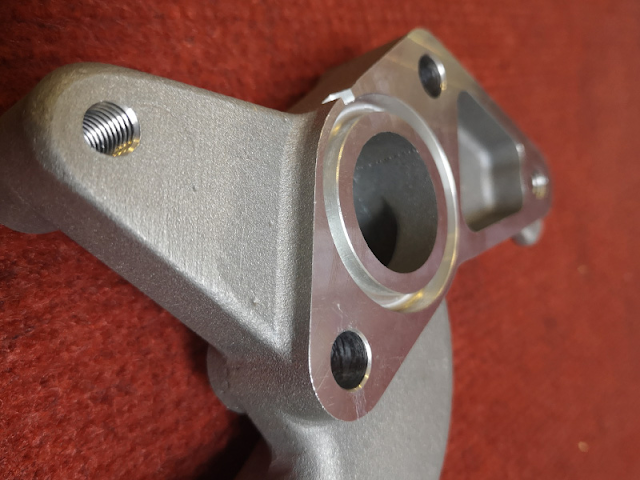
Aluminum mold casting is a method that produces high tolerance and high-quality parts just by pouring molten aluminum into a precisely designed and precision-engineered die, mold, or form. The production of complex, intricate, detailed parts is an efficient process that exactly matches the specifications of the original design.


Aluminum Mold Casting

A positive benefit of aluminum cast parts is the layer of aluminum oxide that is immediately formed after the part is removed from the mold, which against corrosion and rust provides a wall of protection.

The Process of Aluminum Casting Process

For Custom Aluminum Casting one typical method is to pour molten aluminum into a steel mold that has been precision processed to make sure that the cast piece will have an exceptionally smooth and refined surface. This particular process is one such method that is used to produce aluminum castings, each of which is used for creating specific types of parts.

Aluminum Mold Casting

A variation in the casting processes is the type of mold, which is permanently made of steel or is temporarily made of a non-metallic material. Each of the types of castings has its advantages and for their reliability and product quality, they are dependent.

It is important to examine each of the different distinct methods to discuss the aluminum casting process and how they are used since there is not just one process. Some manufacturers are specialized in one or several methods; many producers also give customers a choice as to which process, they would prefer.

Selecting an Alloy to fit an application

While deciding on the type of alloy for an application, the list below serves as a guideline for the properties and characteristics that are necessary.

  • Corrosion Resistance – It is excellent in its natural state but when alloyed it changes
  • Heat Treating – It reduces chemical segregation and improves work ability
  • Strength – measured by tensile strength, temper, and yield
  • Form ability – It can undergo plastic deformation
  • Machining –resistant to low temperatures, bend ability, able to be drilled
  • Weld ability –solidification shrinkage, hydrogen solubility, thermal conductivity, oxide coating
The ability to stipulate the necessary properties is one important advantage of using aluminum for casting. There is an Aluminum Casting Factory of alloy that fit the application no matter what the project is. Determining the required characteristics is all-important.
 
Follow us on Facebook

Thursday, 1 April 2021

Permanent Mold Casting of Aluminum Alloys

In the entire industry, Aluminum casting in permanent molds of steel and iron is widely used, and aluminum, as well as its alloys, make up the huge majority of permanent mold castings. In permanent molds, several methods are used for aluminum mold casting. This article mostly focuses on permanent mold casting with molten aluminum fed by low pressure, vacuum and centrifugal pressure, gravity, and squeeze casting.


Compared to sand castings, permanent-mold castings cool faster than, giving them a much finer, more uniform microstructure. Mechanical properties are boosted by up to 20%. In comparison, much stronger skin is present in pressure-die-cast parts but has weaker sections of the interior.

The process

Large numbers of dimensionally repeatable parts are produced using Permanent molds that are machined from cast iron or steel. In contrast, investment and sand-cast molds during part removal and die casting are destroyed. This also happens under extremely high pressures when molten metal is injected into dies in aluminum casting factory.

Throughout the industry Aluminum casting in steel and iron is permanent. Consequently, dies must be designed to withstand these pressures which compared to gravity-filled permanent molds drastically boost the cost.

With uniform nonporous microstructures, permanent-mold castings can be made, but on solidification rates and foundry tooling designs, these qualities are highly dependent. Molds must be designed carefully with sprue, vents, and risers.

To help ensure controlled laminar flow of the metal into the mold and adequate feed to all sections of the casting design and placement of sprue and gates are critical. The amount of gas entering the melt is minimized by the laminar flow. In castings inordinate amounts of dissolved gas in the melt produce voids.


For areas of a part that otherwise may become isolated, risers act as reservoirs of metal to supply a constant flow. Compared to thick ones thin sections freeze faster. Thus, to continually feed the cavity carefully placed risers are needed as metal contracts during cooling. Because of this phenomenon in aluminum mold casting projects, the void formed is a casting defect known as shrinkage porosity. At last riser, sprue solidifies resulting in what is denoted as directional solidification.


Instances When Permanent Mould Casting Is Preferred

Sand casting and permanent mold casting are two different but related procedures that are each ideally suited to particular situations and r...